

Master’s degree = deepen knowledge + broaden knowledge + learn scientific working methods
The 4-semester Master’s program in Nanotechnology deepens nanotechnological knowledge and scientific working methods. In addition to the five compulsory nanotechnology modules, students take one core subject in materials science and two elective modules in natural sciences and technology.
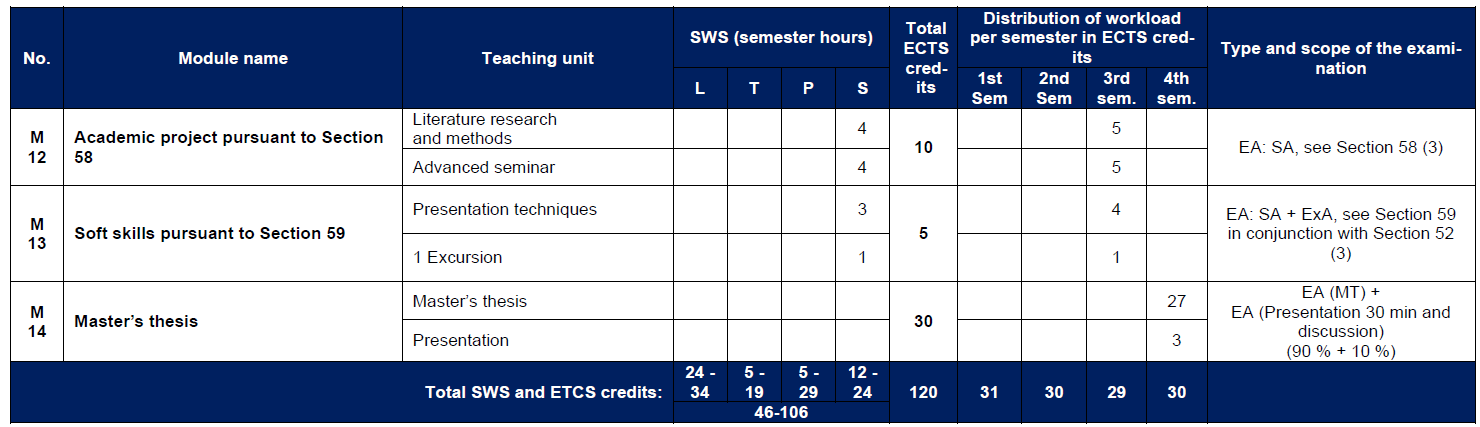
The standard duration of the Master’s program is four semesters. The number of credits required for successful completion is 120 ECTS.
All examinations are taken during the course of study and, with a few exceptions, are oral.
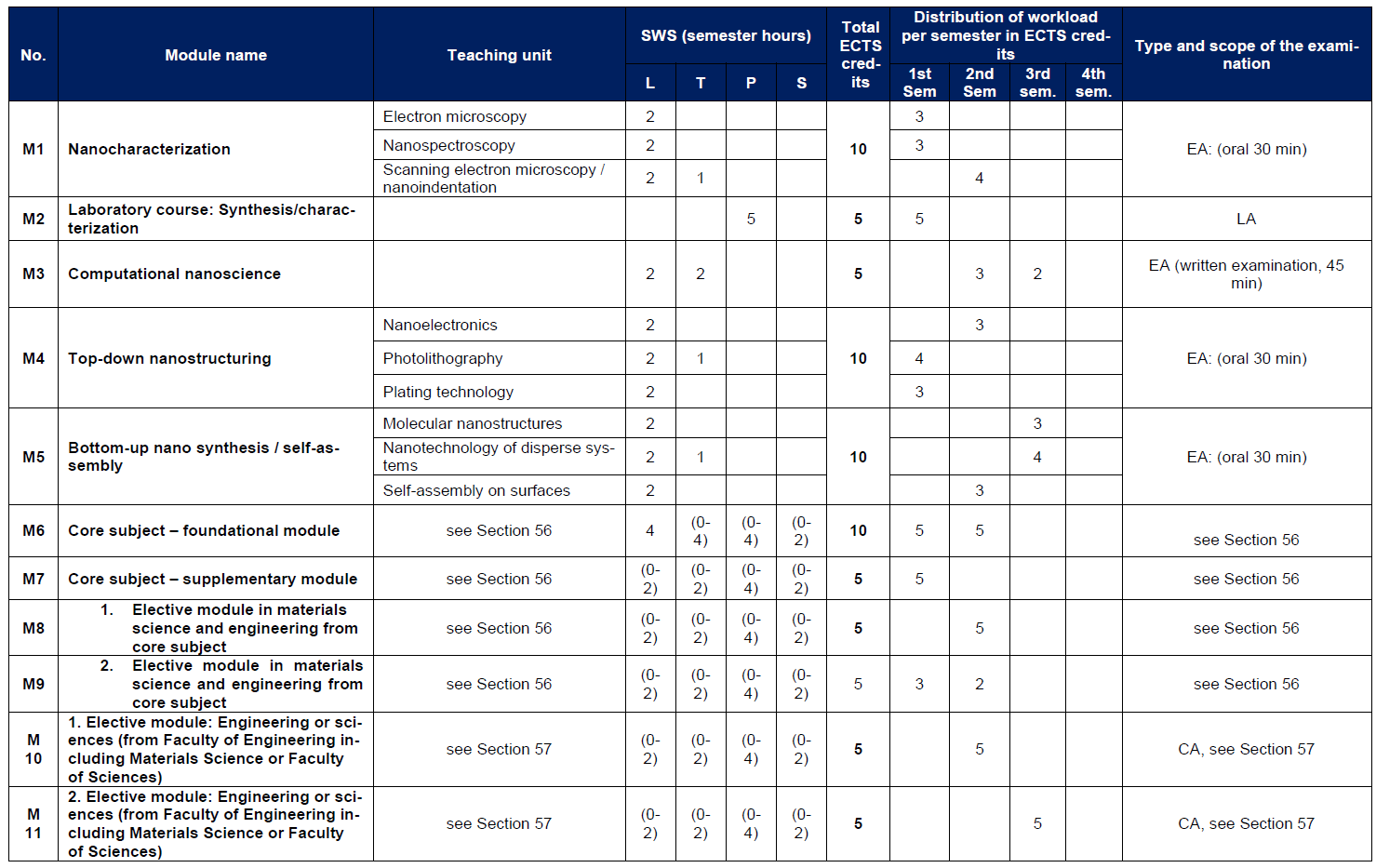
- Nanocharacterization
- Lab Work Synthesis / Characterization
- Computational Nanoscience
- Top-Down Nanostructuring
- Bottom-up Nano-Synthesis/ Self-assembly
The core subject is chosen from the core subject catalog of the master’s program “Materials Science and Engineering”. The following can be selected as core subject:
- General Materials Properties
- Materials Science and Engineering for Metals
- Glass and Ceramics
- Polymer Materials
- Materials for Electronics and Energy Technology
- Biomaterials
- Materials Simulation
- Micro- and Nanostructure Research
The core subject has a scope of 25 ECTS. These are divided into a basic module of 10 ECTS and a supplementary module of 5 ECTS. Both basic and supplementary modules are compulsory modules within the chosen core subject and must be taken. In addition, there are two elective modules of 5 ECTS each, which can be freely selected from the subject pool of the core subject.
Within the framework of the scientific-technical elective module, there is the possibility to take further subjects from the offerings of the study program “Materials Science and Engineering”, from the entire Faculty of Engineering and from the Faculty of Natural Sciences according to personal interest.
In addition to the core and elective subjects, the modules “Scientific Project” (15 ECTS), “Soft Skills” (5 ECTS) and “Master’s Thesis with Presentation” (30 ECTS) must also be taken. Both the module “Scientific Project” and the Master’s thesis are usually taken in the core subject. The module “Soft Skills” is generally taken in one of the three core subjects.
In contrast to the Bachelor’s program, a stay abroad can be integrated into the Master’s program relatively easily and, if necessary, without significant loss of time. The 3rd semester is particularly suitable for this. In consultation with the study advisors or the supervising professors, equivalent study achievements abroad can be accepted.
The Lifelong Learning Program is an action program of the EU Commission to promote general cooperation in the field of education, student and employee mobility in Europe. ERASMUS – as part of the Lifelong Learning Program – offers students the opportunity to gain experience in other European countries, to get to know the language and culture, and to take advantage of the study opportunities offered there.
Students from a wide variety of institutes can spend study periods abroad (i.e. take courses and participate in examinations), as well as practical stays for laboratory or industrial internships or for the completion of their theses or dissertations, in each case for a period of three to twelve months. During this time, they are receive a small monthly stipend and are exempt from any tuition fees at the host university. The only requirements for participation are enrollment at FAU, first-time participation in the program, and sufficient language skills in the target country.
You will find detailled information here.